
In this episode we move away from verticals and start modelling loop antennas.
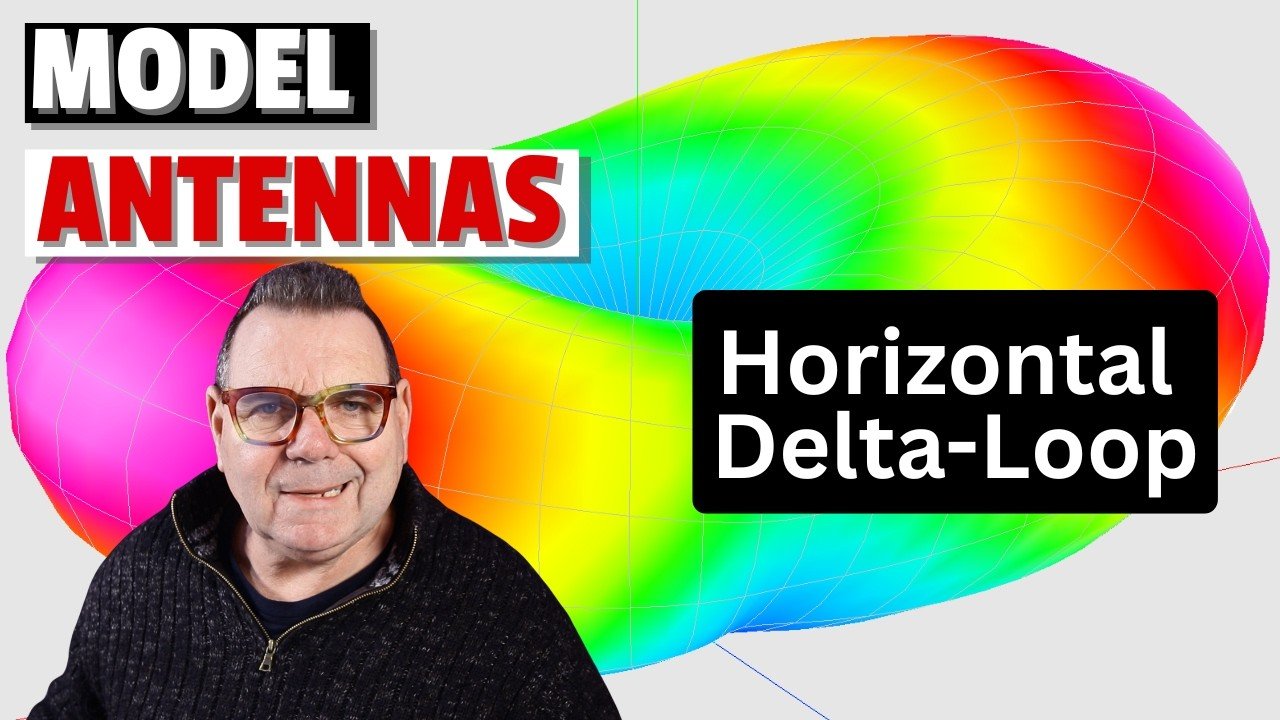
Using MMANA-GAL, we draw a horizontal delta loop and explore how it behaves compared to a vertical antenna.
Along the way we also look at how ground conditions affect antenna performance, and why antennas near salt water can perform dramatically better.
In this video we:
• Benchmark a vertical antenna at low take-off angles
• See how changing ground conductivity affects performance
• Draw a horizontal delta loop using the wire editor
• Place the feedpoint and model a 4:1 balun
• Use wire scaling to tune the antenna to the correct frequency
• Compare the far-field plots of a loop and a vertical
You’ll also see how loop antennas behave on multiple harmonics, making them useful multiband antennas.
In the next episode we’ll convert this into a vertically polarised delta loop and compare the radiation patterns again.
Software used
MMANA-GAL (Basic version)
Free download:
http://gal-ana.de/basicmm/en/
Model files used in this series
All MMANA-GAL antenna models used in these tutorials can be downloaded here:
📁 https://mega.nz/folder/EnoXlTQL#Iuq-TqnW7ZglzkJMEIk59w
This folder will be updated as new videos in the series are released.
Full Video Playlist
📺 https://www.youtube.com/playlist?list=PLcC64tNkZB7zl-6HKJ5ihuSH3-22IX6kq
If you want to follow the whole modelling series, subscribe so you don’t miss the next episode.
source